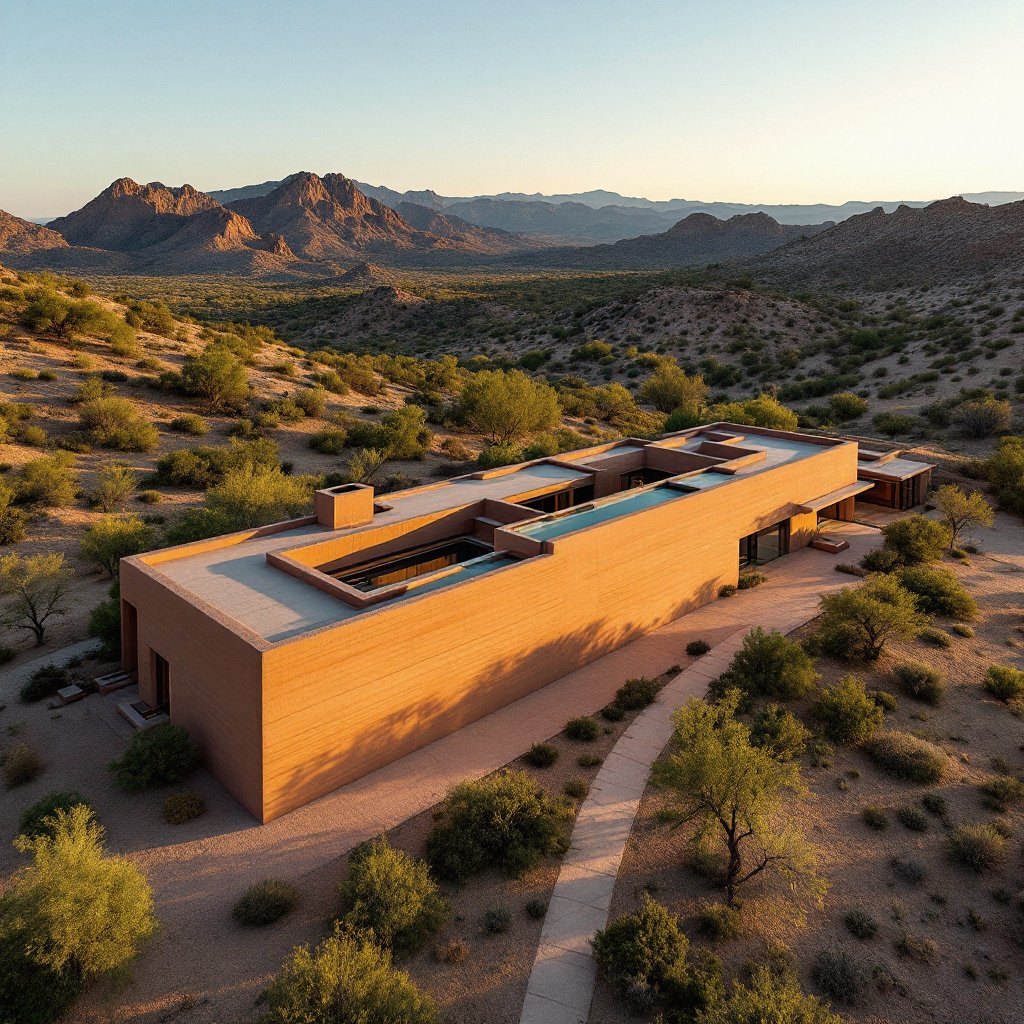
Tucson and the Sonoran high desert are the spiritual home of modern American rammed earth. We build here at the standard the tradition deserves, estates from $1M.
Request a Consultation Call (307) 217-5491Physics and lineage. The Sonoran climate is the material's perfect theater: intense diurnal temperature swings that thermal mass converts into effortless comfort, walls absorbing the day's heat and releasing it into cool desert nights, halving what mechanical systems must do. And the lineage is real: Tucson's mid-century earth builders made Arizona the proving ground of modern American rammed earth, and the state's appraisers, lenders and building departments have seen the material succeed for decades. Nowhere in America is it easier to say yes to earth.
Monsoon season drives roof overhang and drainage detailing; wildfire zones in the interfaces make non-combustible mass walls an underwriting advantage; and solar orientation is everything: a south-facing mass wall here is a passive appliance. Insulated assemblies (earth-insulation-earth sandwiches) are specified where owners want modern energy code performance with pure strata faces inside and out.
The Sonoran and transition-zone soils we work read like a paint catalog: iron-rich reds around Sedona and the Verde Valley that carry their oxide straight into the strata; granitic decomposed soils in the foothills that bring sparkle and structure; caliche layers around Phoenix that demand excavation judgment but reward it with superb aggregate; and Tucson-basin blends with the buff-rose signature that made this region's walls famous. Every parcel gets sampled before design, Arizona's geology is generous, but it's not uniform, and the difference between a good wall and an unforgettable one is often two test pits and an oxide decision.
Arizona is where mass-wall passive design pays its full dividend, and we design for it explicitly: south glazing sized to winter sun angles with mass floors and walls positioned to bank it; deep overhangs calculated to exclude summer sun entirely; west faces defended with earth, not glass (the Arizona rookie mistake is a west-facing window wall); courtyards that pre-cool evening air; and night-flush ventilation paths that recharge the walls' coolness in the hours the desert gives it away free. Owners report the signature experience within the first July: stepping inside at 4pm to a house that simply hasn't noticed the afternoon.
Arizona's jurisdictions know this material, Pima County in particular has decades of earthen-building precedent, and Maricopa, Yavapai and Coconino counties all process stamped rammed earth documentation routinely. HOA design review in Scottsdale and Paradise Valley responds well to the material's mockup-first process (physical strata panels beat renderings in any design-review room). Wildfire-interface parcels in the high country gain a genuine underwriting conversation: mineral walls, ember-resistant detailing and defensible-space landscaping make a package insurers increasingly reward.
Every Arizona wall gets what the old builders called good boots and a good hat, sized for this state's particular weather theater. The hat: roof overhangs of 24–36 inches at minimum, deepened on exposure faces, with scuppers and gutters sized to cloudburst rates rather than annual averages: a monsoon cell can deliver an inch of rain in twenty minutes, and the roof's one job in that moment is to throw the water well clear of the wall face. The boots: concrete stem walls that lift the earthen wythe above grade and splash line, paired with finish grading that carries water away from the building quickly and a drainage course where roof water lands. The wall face itself is finished in breathable water repellents that shed liquid while letting vapor migrate outward. Detailed this way, an earthen wall takes a monsoon burst, sheds it, and is dry again before the storm cell clears the valley: the same discipline that has kept pisé buildings standing through two centuries of weather far wetter than Arizona's.
Wildfire detailing is the other half of the Arizona brief, and the material starts that conversation with an unfair advantage: a rammed earth wall is mineral through and through, 18 to 24 inches of compacted ground containing nothing that burns. We complete the package with ember-conscious detailing at the points fire science actually flags: fine-mesh screening at every vent, enclosed or non-combustible eave construction, metal roofing, and exterior palettes limited to earth, steel, stone and glass. Add defensible-space landscaping designed with the architecture rather than bolted on afterward, and the result is a house that gives an ember storm remarkably little to work with. In the wildland-urban interface (Prescott's pine fringe, the Catalina foothills, Sedona's canyon edges) that is not an aesthetic argument. It is an insurance conversation that goes better than any framed house's ever will.
Arizona is not one climate; it is a staircase of climates, and the wall assembly should climb it. The same 18–24 inch mass that runs uninsulated in the low desert wants a continuous insulation core by the time the road reaches ponderosa country. Here is how we read the four markets we are asked about most.
| Market | Elevation | Climate reality | Design response |
|---|---|---|---|
| Phoenix / Scottsdale | 1,100–1,600 ft | Extreme summer heat, mild winters, violent monsoon bursts | Shading geometry first: deep overhangs, courtyards, defended west faces, night-flush ventilation; mass walls carry the diurnal load |
| Tucson / Catalina foothills | 2,400–3,200 ft | Classic Sonoran diurnal swings, the material's textbook climate | The tradition's home detailing: mass-forward design, monsoon boots and hat, strata blended to the basin's buff-rose signature |
| Sedona / Verde Valley | 3,300–4,500 ft | Hot days, genuinely cold nights, occasional snow | Insulated-core assemblies recommended; iron-oxide strata matched to the red rock; fire-interface detailing on canyon parcels |
| Prescott / high country | 5,000–5,500 ft | Four real seasons, hard freezes, snow load | Full double-wythe insulated-core wall, snow-rated overhangs, stem walls detailed for freeze; the same assembly our Tennessee and Indiana builds carry |
The Nk'Mip Desert Cultural Centre in British Columbia showed in 2006 what institutional rammed earth can be, a long, stratified wall that became the region's architectural signature. Arizona's hospitality economy is the natural American home for that ambition. Resort arrival walls and spa interiors trade precisely on what mass earth delivers: monumental calm, acoustic deadness, and a material story no imported stone can tell. The wine country rising in the Verde Valley and around Willcox is an equally obvious fit, tasting rooms with the thermal steadiness cellars want and the photogenic gravity tasting-room economics reward. Civic and cultural commissions round out the field; a state whose identity is geology should have public buildings made of it. Commercial wall work runs $50–$225 per square foot of wall face depending on height, finish and access, and we build it across the same footprint as our homes.
We walk parcels with clients before they close, and the desert checklist is consistent:
Because the comparables exist. The Tucson revival built decades of rammed earth stock, which means Arizona appraisers can pull genuine sold-price history instead of guessing, lenders have already closed on the asset class, and insurers have watched mineral-walled houses outperform in fire country. In our newer markets we bring precedent packets to those conversations; in Arizona, the precedent is standing on the ground, and has been since before most loan officers were born. Construction lending still follows the standard draw-schedule mechanics of any custom estate (our fixed-scope contract and milestone documentation are built for exactly that review) but the appraisal conversation that stalls earthen projects elsewhere is, here, a short one. If you have been told an earth home cannot be financed, you were told that in the wrong state.
Building in the Valley of the Sun? Our dedicated Phoenix & Scottsdale guide covers the estate corridors from Paradise Valley to Carefree, orientation, monsoon detailing, soils and design review, in depth.
Building in the heartland itself? The Tucson & Catalina foothills guide covers the basin’s buff-rose soils, the foothills corridors and why appraisal comparables actually exist here.
Building on estate ground under Camelback and Mummy Mountain? The Paradise Valley guide covers hillside review, monsoon detailing, the town’s fixed land supply and what a mass wall does to a Sonoran cooling load.
Scottsdale sits under its own rulebook. The Scottsdale guide walks the McDowell Sonoran hillside standards, the Silverleaf and Desert Mountain corridors, decomposed granite and caliche soils, and how HOA architectural review reads a monolithic earth wall.
Up on the Colorado Plateau, color is regulated. The Sedona guide covers the red rock viewshed rules, why native pigment is an advantage in a jurisdiction that caps reflectivity, the real four-season swing at 4,300 feet, and wildfire exposure at the wildland urban interface.
Request a Consultation Call (307) 217-5491
