Soil, compacted inside forms until it behaves like sedimentary stone. Older than Rome, newer than this year's energy code: here is the material, explained properly.
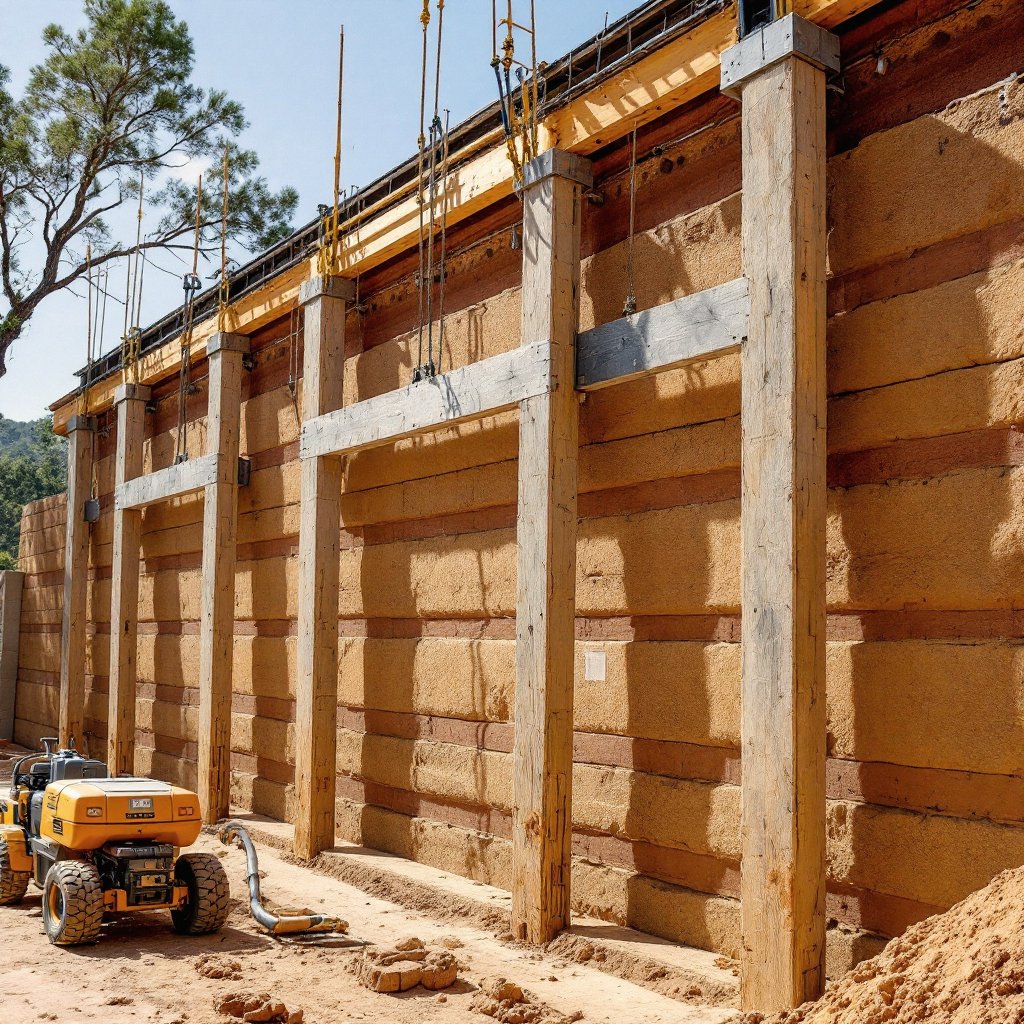
Request a Consultation Call (307) 217-5491Rammed earth is a construction method in which a moist, engineered mix of soil (clay, silt, sand and aggregate, usually stabilized with a small fraction of cement or lime) is compacted in layers inside rigid formwork. Each loose 6–8 inch "lift" is rammed down to roughly half its height with pneumatic tampers. When the forms come off, what remains is a monolithic wall with the density of soft stone and the layered strata of a canyon face: structure, insulation mass, and finished surface in a single material.
Older than most civilizations that used it. Sections of the Great Wall of China were rammed from earth over 2,000 years ago and stand today; the technique built city walls in ancient Carthage, farmhouses across France and Germany (where immigrants carried it to 18th and 19th century America), and courthouses and churches from New York to Florida. The modern revival began in the American Southwest and Australia in the late 20th century, adding engineering: soil labs, stabilization, formwork systems and structural stamps. What you commission today is an ancient idea wearing modern mathematics.
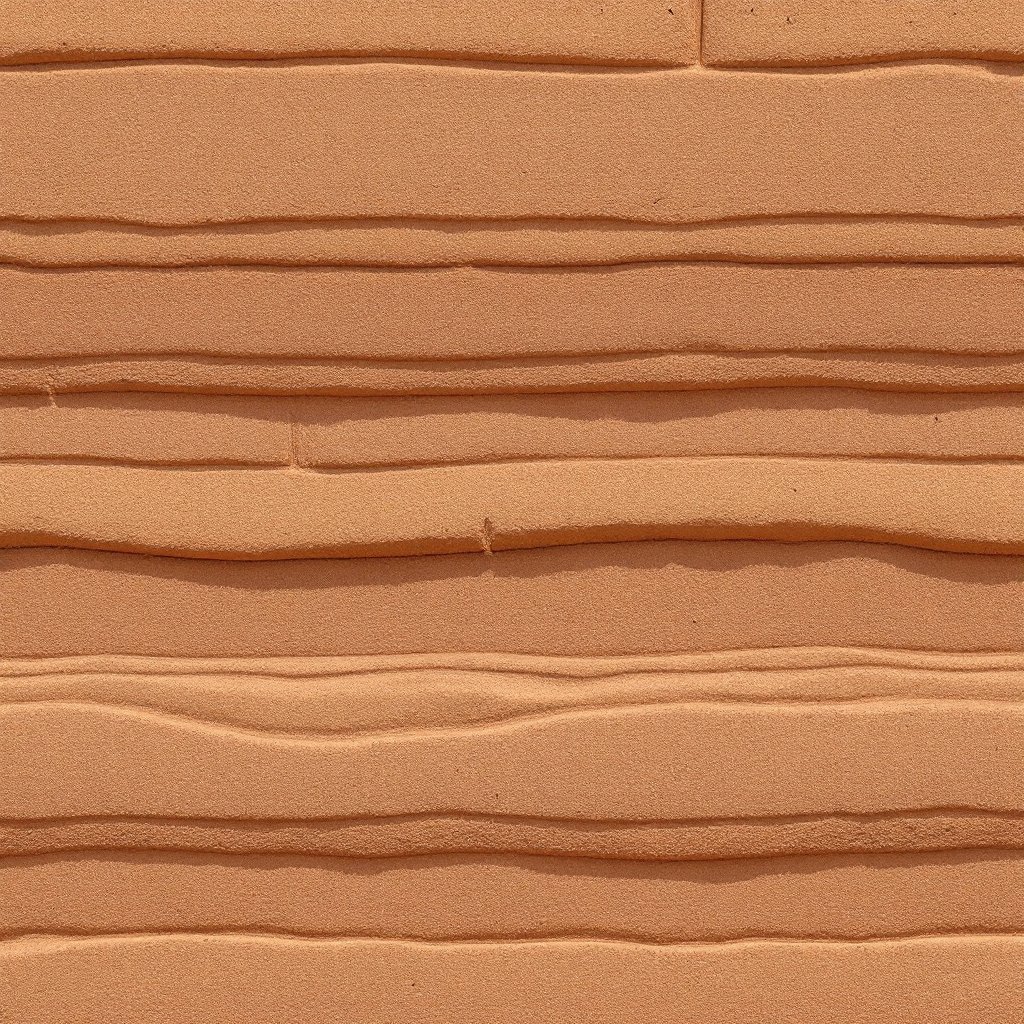
Each stratum is one lift of compaction. Builders vary soil blends subtly between lifts (a touch more iron oxide here, a sandier mix there) so the finished wall reads like geological time made architectural. No two walls can ever match, which is precisely the luxury argument: your walls are a fingerprint of your ground and your build week.
Traditional walls were unstabilized, pure soil, maintained across generations. Modern engineered walls add 5–10% cement or lime stabilization for code compliance and weather resistance, insulation cores where energy codes demand them (Tennessee, Kentucky, Indiana), and embedded conduit for modern systems. Purists debate; building departments don't. Bighorn builds engineered walls, the tradition, made permittable.
As the material trends, imitations multiply, here's how to tell the real thing from the lookalikes. True rammed earth shows continuous horizontal strata that wrap corners without joints: the bands flow around the building because the wall is one compacted mass. Printed or veneer 'strata panels' betray themselves at corners and edges, where the pattern breaks or repeats. Touch is the second test: real walls read as matte, mineral, slightly granular stone, never the uniform coolness of concrete or the papery flatness of textured plaster. And openings tell the final truth: real rammed earth shows the wall's full 18–24 inch depth at every window; veneers show an inch. When a hotel lobby claims rammed earth, check the reveals.
What Americans call rammed earth, the French call pisé de terre, the technique that built Lyon's countryside. In China it's hangtu, the method under sections of the Great Wall and the fortified tulou houses of Fujian. Morocco's kasbahs, Yemen's earthen towers, the Alhambra's ramparts in Spain, Bhutanese dzongs, the same idea, evolved on every inhabited continent. Australia industrialized the modern stabilized form in the 1970s–90s (Western Australia's Margaret River region is dense with contemporary examples), while the American Southwest ran a parallel revival that professionalized soil labs, formwork engineering and code pathways. Today's premium builds in California wine country, Colorado's resort valleys and our own four states are the newest branches of a very old tree.
For the client building a reference library: the Great Wall's rammed sections (2,000+ years); France's pisé farmhouses of the Rhône-Alpes, many still inhabited after three centuries; South Carolina's Church of the Holy Cross at Stateburg (1850, National Historic Landmark, rammed earth); the Nk'Mip Desert Cultural Centre in British Columbia, whose 260-foot insulated wall proved the modern cold-climate assembly; and Arizona's decades of contemporary desert homes that made the American Southwest the material's proving ground. Every one is an argument in the same direction: this is not an experiment.
Every trade has a vocabulary, and rammed earth's is older than most. These are the terms you'll meet in our proposals, in engineering documents and throughout this hub, defined plainly, without the mystique.
| Term | What it means |
|---|---|
| Pisé | The French name for rammed earth (pisé de terre), still standard in technical literature and historic records. |
| Lift | One layer of moist earth placed in the form, typically 6–8 inches loose, compacting down to 4–5 inches. Walls rise lift by lift. |
| Formwork | The temporary mold that shapes and braces the wall while it's rammed, struck away once each section is complete. |
| Stabilization | A small measure of cement or lime (usually 5–10%) blended in to lock in strength and weather resistance. |
| SIRE / insulated rammed earth | Stabilized insulated rammed earth: two rammed layers around a rigid insulation core, the standard four-season assembly. |
| Wythe | One vertical layer of a wall. An insulated rammed earth wall has two wythes with the insulation between them. |
| Bond beam | The reinforced concrete cap along the wall top that ties the structure together and carries the roof. |
| Thermal mass | The wall's capacity to absorb, store and slowly release heat, the engine behind its steady interior temperatures. |
| Breathability | The wall's ability to absorb and release water vapor rather than trapping it, one reason earthen walls resist mold. |
| Proctor test | The lab test that finds a soil's optimum moisture content, the exact dampness at which it compacts densest. |
| Atterberg limits | Lab measurements of how a soil's clay behaves with water, when it turns plastic, when it flows. They predict shrinkage before a lift is rammed. |
| Oxide | Natural mineral pigment blended into a lift to tune its color, how banded walls get their palette. |
| Strata | The visible horizontal banding left by successive lifts, the material's signature. |
| Cold joint | The seam where one day's ramming ends and the next begins. Planned and detailed, it's invisible structure; ignored, it's a weakness. |
| Coving | Erosion undercutting the base of a wall, the classic failure of neglected historic earth walls, prevented by stem walls and drainage. |
| Stem wall | The concrete plinth that lifts earthen material above grade, out of reach of splashback and standing water. |
| Optimum moisture | The narrow moisture window at which soil compacts hardest, dry enough to ram, damp enough to bind. |
"Earth building" is a family, not a single method, and listings, articles and even contractors regularly blur the branches. The differences matter (structurally and financially.
Rammed earth's distinction is compaction inside engineered formwork: densities of 120–140 pounds per cubic foot, a monolithic structure, and the layered strata only ramming produces.
Read a finished wall like a section drawing and the whole system reveals itself:
Everything above works as one system, which is why we design walls as assemblies rather than as a material pasted onto a conventional plan.

Request a Consultation Call (307) 217-5491
