The specialist shortage is the biggest risk in American rammed earth. Seven questions separate the craftsmen from the improvisers, and any builder worth hiring will enjoy answering them.
Request a Consultation Call (307) 217-5491The hardest part of commissioning a rammed earth home in most of America isn't the budget, the design or the permit. It's that the number of crews who can execute the walls properly is tiny, and the number who will claim they can is not. Since a failed earth wall is the most expensive kind, here is the vetting interview we'd give our own family. A real specialist will enjoy these questions; watch for that, too.
The answer should include sieve analysis, Atterberg limits, Proctor curves and test cylinders, named without hesitation. "We can just tell good dirt" is the sound of your future wall cracking.
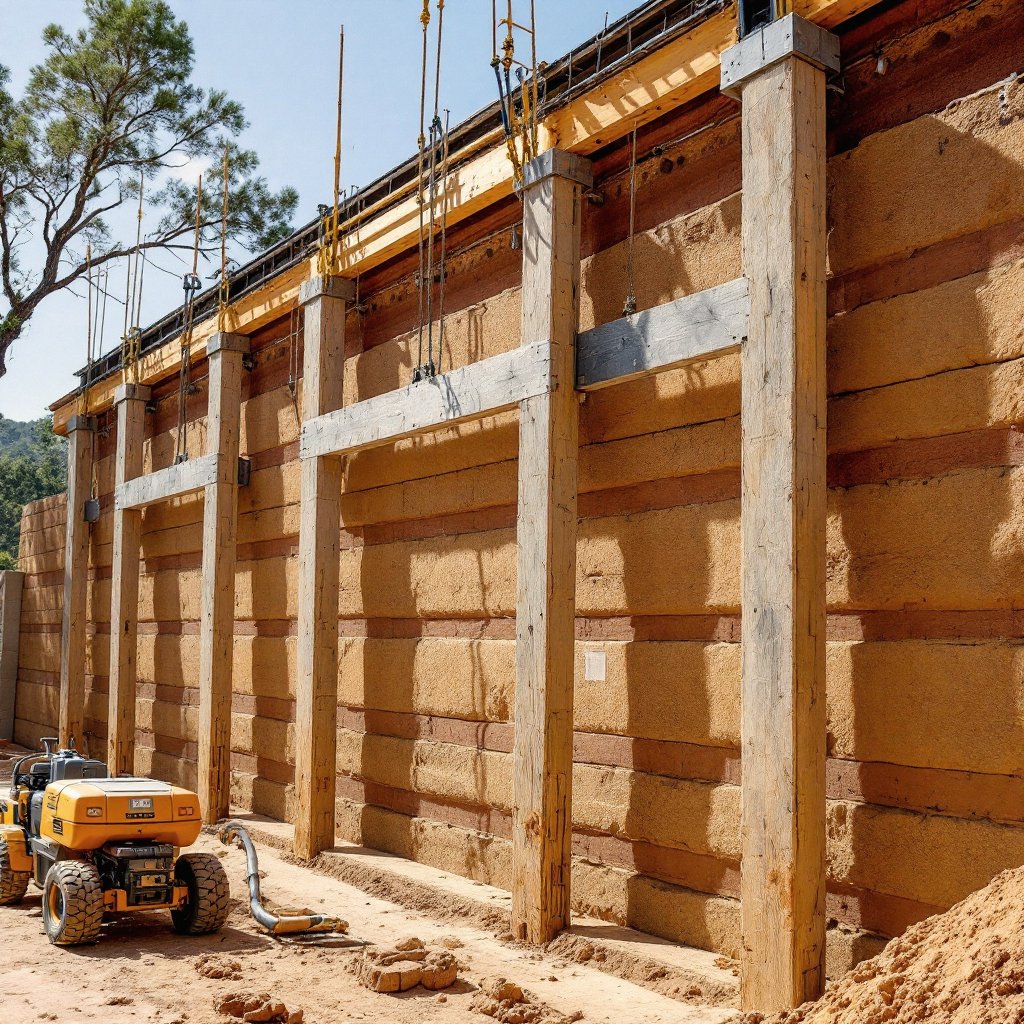
Compaction forces blow out improvised forms weekly somewhere in the world. Engineered systems, torque-checked ties and survey verification are the professional answers.
The right answer is conditional (climate, exposure, code, engineering) usually landing at 5–10% with reasons. A flat answer ("we always use X") means the recipe isn't being engineered for you.
Stem walls, overhangs, copings, breathable sealers: the boots-and-hat catechism should pour out fluently. Water detailing is where centuries are won or lost.
Density logs and cylinder breaks exist for every professionally built wall. Specialists produce them proudly and instantly.
A real crew talks about surface prep and lift-interval discipline against cold joints. Blank stares here predict delamination there.
The best question of all. Specialists have honest answers (chronic-moisture sites, hostile budgets, impossible timelines) because they've declined projects before. Anyone who says the material is right for everyone is selling, not building.
We publish this list knowing competitors' clients will use it, good. A market that vets its builders well is a market where the material's reputation compounds, and rammed earth's reputation is an asset we all share. Interview us with the same list: the consultation is where we enjoy it.
A checklist is only as useful as your ear for the responses, so here is each question again with the two answers you'll actually hear: the one that should reassure you and the one that should end the meeting politely.
The great answer arrives with paperwork: sample reports from past projects, a named geotechnical lab, and an unprompted explanation of why a particular clay fraction was blended down. Specialists talk about soil the way sommeliers talk about vintages, specifically, and with opinions. The red flag is folk wisdom dressed as experience: "we've been moving dirt for thirty years, we know good material when we see it." Experience matters enormously in this craft, but it supplements the lab; it never replaces it. Soil that looks perfect can hide expansive clays that will spend a decade tearing your wall apart from inside.
The great answer names the system, the engineer who reviewed it, and the pressures involved, because a crew ramming lifts generates lateral forces that treat plywood improvisations as suggestions. You want to hear about torque checks on ties and survey verification of plumb as routine, not heroics. The red flag is "we build our forms on site, saves you money." It does save money, right up until a blowout dumps a day's lift on the ground, or worse, doesn't fail visibly and leaves a bulged, out-of-tolerance wall you now own.
The great answer is conditional and slightly annoying: "it depends on your soil, your climate exposure and what the engineer requires, typically we land between 5 and 10%, and here's what pushes it either way." Conditional answers are what engineering sounds like. The red flag is a single number delivered with total confidence for a site the builder hasn't tested. A recipe that never changes is a recipe designed for someone else's dirt.
The great answer is fluent and bored, in the best way, stem walls, overhangs, copings, breathable sealers recited like a catechism the builder has performed a hundred times, ideally with the reasons attached. The red flag is any suggestion that water is a solved problem because "the walls are stabilized." Stabilization is one instrument in the orchestra; a builder who thinks it's the whole score has never inspected a coved wall base. Ours have. It's most of our repair inquiries.
The great answer is a binder or a folder link produced on the spot: density logs by lift, cylinder break results, dates, wall locations. Professionals document because engineers, lenders and building officials require it, the records exist whether or not you ask. The red flag is "we can put something together for you." Records assembled after the question are not records; they're homework.
The great answer gets pleasantly technical about the least glamorous subject on the list: how the crew preps a lift surface after an overnight stop, what interval discipline they hold, how weather delays are handled. Anyone who has actually rammed walls has strong feelings here. The red flag is a blank beat followed by improvisation. Delamination between lifts is invisible on day one and structural by year ten; this question is your only cheap chance to see it coming.
The great answer comes with scar tissue: a site they walked away from, a budget that couldn't carry the material honestly, a client steered toward conventional construction. Builders who have declined work have standards; the declining is the evidence. The red flag is enthusiasm without conditions, "rammed earth works everywhere, for everyone." That's not confidence in the material. That's a sales quota wearing its vocabulary.
Price deserves its own paranoia. When one rammed earth bid arrives dramatically under the field, it is almost never a smarter builder; it is a different scope wearing the same project name. The discount hides in predictable places: no soil testing budget (the dirt will be "fine"), improvised formwork, stabilization bought by the flat number rather than the engineered one, water detailing "value-engineered" to a coat of the wrong sealer, no mockup, no QA documentation, and a schedule that assumes weather doesn't happen. Each omission is invisible in a proposal and expensive in a wall. Walls run $50–$225 per square foot of face and turnkey homes $250–$450+ per square foot for reasons that are mostly non-negotiable physics and labor; a bid materially below the range isn't beating the market, it's quietly exiting the specification. Ask the low bidder to itemize against the seven questions above and watch the number climb back to earth.
Vetting continues into the paperwork. Whoever you hire (including us), insist on terms like these:
None of this offends a real specialist. Every item is something we'd volunteer anyway, and the builders these terms scare off are precisely the ones they exist to scare off.
A cynic will note that a builder handing out a vetting interview is also handing its competitors' clients a weapon, and the cynic is right. We've thought about it and keep publishing anyway, for an unsentimental reason: rammed earth's reputation is a commons. Every improvised wall that fails becomes a photograph that costs all of us clients for a decade; every rigorously built one is an argument for the material that no marketing budget could buy. A market that interviews its builders hard is a market where the craft compounds instead of eroding, and, less nobly, we do fine in hard interviews. Bring the list. Bring it to everyone. Especially bring it to us.
